Author Note: Reposted from January 6, 2025
As of this writing, it is January 6, the fifth anniversary of the storming of the US capitol, where Trump Supporters rushed the capitol on the false pretense of voter fraud. This day featured chaos and division primarily shaped by the actions of Donald Trump and his supporters in the aftermath of his defeat in the 2020 election. When Donald Trump officially left office, it seemed like his political career was over. This dark cloud over Mr. Trump was made even larger when he was faced with 86 felony counts between 40 counts of mishandling classified documents at his Mar-a-Lago estate, eight counts of trying to interfere in an election in Georgia, and his scheme to overthrow the 2020 election results on four counts. This past May, Trump was also convicted on 34 felony counts related to falsifying business records in connection with hush money payments to Stormy Daniels.
Yet, even after his response to the 2020 presidential election and the tag of felon attached to him, he has remained embedded in the American political and cultural climate. Few could have predicted that five years after January 6, Trump would return to power, cementing one of the most shocking political comebacks in history.
This remarkable feat has left many wondering: How did this happen? When diving into political matters, the answer is usually complicated, and this is no different. Many factors are to blame for Vice President Kamala Harris and the Democrats’ loss and Trump’s subsequent victory, ranging from the economy to domestic and foreign policy. and the vice president’s late entrance as the main contestant in the race. However, since I am a communicator and this is a blog for communication and not politics, I want to address the broader messaging strategy and media environment that led to such a consequential moment in our country’s history.
The Rise of Alternative Media

If the 2024 election told us anything from a communications perspective, it is this: mainstream media is dead or at least on life support. The way the modern world consumes media has changed. Traditional media outlets such as cable news and newspapers are now in competition with alternative media, and they are losing. Independent journalism, social media, and podcasts have largely overtaken how Americans consume their news and entertainment. Cable television ratings have plummeted, and digital media is starting to get almost double the number of views. For example, notable news networks like CNN lost 45% of their primetime viewership in 2024. More generally, cable television subscriptions saw another year of rapid decline to 68.7 million people in the face of the continued rise of digital streaming services.
Americans, especially those aged 18-35, have turned to the new media ecosystem. YouTube, TikTok, and Instagram have all become primary news sources for the younger generations. This content isn’t just to inform, but it entertains as well. The new medium lends itself to being raw and off the cuff, unlike large news organizations that are often more restricted in content.
Meeting people where they are.
The 2024 election cycle saw both the Donald Trump and Kamala Harris campaigns utilize digital media, including podcasts, which have become a staple in online media that create long-form conversations between hosts and their guests. In 2024, the global podcast audience reached approximately 546.7 million listeners, marking a 7.85% increase from 2023. Kamala Harris made notable appearances on podcasts such as Call Her Daddy, All the Smoke, and Club Shay Shay. At the same time, Trump made multiple podcast appearances this year, including The Joe Rogan Experience, This Past Weekend with Theo Von, Impaulsive, and the Flagrant Podcast. The most popular of these was The Joe Rogan Experience, which steamrolled to 26 million views in the first 24 hours of its release and has currently amassed 53 million views.
While both campaigns embraced digital media to an extent, the Trump team sought out digital media appearances at a higher rate than the Harris campaign did. In the last two weeks before the election, there was much analysis on whether Mrs. Harris would participate in an interview with the most prominent podcaster in the world, Joe Rogan. The results were that she did not go on the platform and ceded millions of views to only Trump’s perspective, who, as mentioned, would go on to the podcast. This decision was met with skepticism from her opposition and even some allies, especially those more in tune with alternative media, and symbolized a broader challenge for the Harris campaign: a cautious approach to alternative media that limited her ability to tap into politically disengaged but culturally influential audiences who view podcasts like Rogan’s as a trusted space for open dialogue. Meanwhile, Trump’s campaigs strategy was to meet the people where they were. Which is now on digital spaces. They effectively bypassed traditional media gatekeepers and tapped directly into cultural conversations that appealed to millions of voters who don’t typically consume politics. This strategy showed fruit as Trump surprisingly made key improvements in young voters and voters of color.

Exit polls showed that Trump increased his share of voters aged 18–29, particularly among young men, who favored him by a 14-point margin (56% to 42%). This shift wasn’t limited to one demographic. He also made gains among voters of color. Support from Hispanic voters climbed from 32% in 2020 to 45% in 2024, and support among Black voters rose to 13%, up from previous elections. Even among Asian voters, Trump increased his share from 34% to 38%. Additionally, 55% of first-time voters supported Trump, while only 44% backed Vice President Kamala Harris.
Through these gains, Trump secured an electoral college victory, and the Republican party’s first popular vote win in 20 years. This suggests that Trump’s message had broader appeal than it did when he lost in 2020 and even when he won in 2016. As communicators, this reinforces a crucial lesson: the platform matters as much as the message, and meeting audiences where they are is key to breaking through.
Communication, especially political communication, isn’t always about how you transmit a message or the contents of that message. Sometimes, it’s how you can present yourself as a brand to others. To some, Donald Trump is more than a politician; he’s more of a successful businessman who tries to present himself as a fighter for the ordinary American. When he or one of his allies goes on to these platforms, they try not to act as the usual politician who focuses on policy over everything else. You can see this for yourself when the president-elect went on This Past Weekend with Theo Von and talked about his brother’s alcohol addiction or when he told a funny anecdote that sounds out of this world. These moments are communicated to humanize him and connect him to others who might have gone through the same thing. Going on a podcast is an amazing storytelling device because these formats are conversational. The host and the guest get to go back and forth in a more in-depth way than one would in a traditional interview format. The podcast format also lends itself to you introducing yourself to a whole different audience. That audience is already a fan of the host, and when you have an appearance that connects with the host, the audience usually connects to you.
By leveraging these platforms, Trump wasn’t just delivering a message; he was embedding himself in the cultural spaces where younger, more diverse audiences already felt comfortable. This approach allowed him to create moments that felt authentic and engaging rather than rehearsed and distant as what usually happens when other politicians go on these platforms.
A nationalized media landscape.
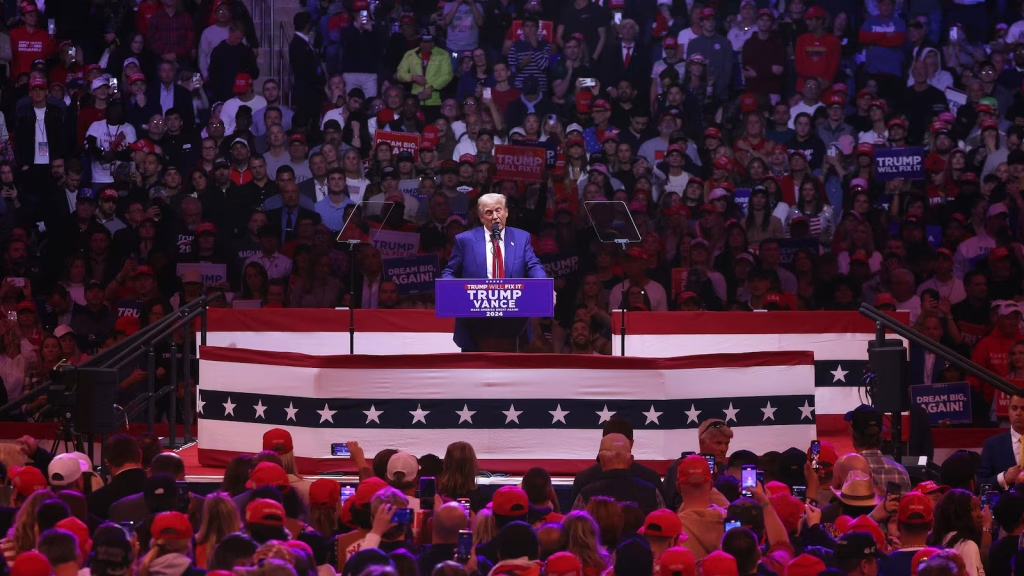
Along with the decline of traditional mainstream media is local media. In recent years, the number of local reporters has decreased, and stations have scaled down operations. This was another thing that the Trump team recognized in this past election cycle. President Trump did not do one of his most significant campaign events in a crucial swing state at a smaller venue. He decided to create a massive event in New York City at Madison Square Garden. This move ignited controversy among the media and political commentators. Some related this event to a 1939 pro-Nazi rally that saw far-right extremist rhetoric under the guise of perceived patriotism. To make things worse, the event did not start as smoothly as the Trump campaign probably wanted when Tony Hinchcliffe made a “joke” that Puerto Rico was a “floating island of garbage.” However, as we across the political spectrum know, Donald Trump has an uncanny ability to withstand even the most fiery controversy.
Despite the rough start, this event achieved its goal of becoming a national spectacle. The visuals of a packed arena and the larger-than-life energy with pro-Trump celebrities, including Elon Musk, Hulk Hogan, Tucker Carlson, and Robert F. Kennedy Jr. resonated far beyond those in the Garden. The rally became a trending topic; clips were shared on YouTube and TikTok, ensuring that voters in swing states such as Michigan, Wisconsin, Arizona, and Georgia, states that are thousands of miles away, could still feel connected to the message at the event. As those in the PR industry know, making the news is a good thing. The rally was delivered locally and nationally through our current mechanisms with the more nationalized media environment.
What Democrats get wrong.

Kamala Harris and the Democratic party lost this election for several reasons. The consequence of global inflation was chief among them, and it has sunk many incumbent parties worldwide regardless of placement on the political spectrum. On this blog, though, I want to focus solely on the communication and messaging strategies that hurt the vice president’s election chances and the best way for the party to move forward in a new age.
- Media Messaging.
The 2024 election was a wake-up call to the DNC. Democrats didn’t just lose the presidency to their main rival, Donald Trump; they lost the popular vote for the first time in 20 years, the House, and the Senate. They also fumbled with swaths of demographics that usually show up on election day to vote for them in droves, including people of color and younger voters. At the heart of the 2024 election loss is the absence of a unifying brand and message. The party struggled to present a clear, compelling vision of why the Democrats have a better policy than their opposition and why their leadership is needed in uncertain times. This happened for a few reasons:
- Too much defense, not enough offense. – Since 2016, the Democrats have been put in a defensive position, often allowing their opponents to set the narrative. In the day of social media, this can be particularly lethal to your brand as it allows opposition parties to constantly attack and set headlines that make your organization look bad regardless of whether their claims are true or false. Always being reactive to attacks and events means that you are never setting the narrative yourself and not bringing a positive message to the table. Voters never see what you are about and how you will improve their lives. They only see what you are against.
- One-fits-all approach – The United States is a massive country. What makes our country so great is that we are diverse in our ways of living, our accents, and different cultures. As communicators, we know that it is important to connect with and respect the needs of your targeted audience. This should be no different in political communication. Yet, for some reason, democrats seem to nationalize their message and as a result miss connecting with voters less naturally inclined to your message, which hurts voter tallies in swing states and rural areas.
- Misunderstanding the digital space – While Mrs. Harris made some notable podcast appearances, there still seems to be a misunderstanding of how the digital landscape compares to the traditional one. The digital space is a lot like the Wild West. It’s supposed to be raw, unfiltered, and more authentic than what you would find on traditional formats like television and magazines. However, the Harris campaign seemed to play it safe when engaging with online influencers and platforms such as podcasts. Take for example, her appearance on the Call Her Daddy podcast with Alex Cooper. The show which is usually casual and conversational, felt more like a well-rehearsed speech on various policy ideas she has. While letting people know about what you believe are the best policies to improve our country is important, not creating an informal atmosphere is a missed opportunity to connect with the podcast audience on a personal and emotional level. In contrast, when you look at Trump’s podcast appearances, you can see how he connected with people, even those who might disagree with his policy. From telling ridiculous anecdotes about whales on Joe Rogan to talking about his brother’s alcohol addiction with Theo Von, these moments are not constrained to one format. They make their way to social media, which makes these moments go viral, reaching those who are and are not tuned into politics, which gives Trump a broader appeal
- Fractured Media Ecosystem – Another significant issue is the lack of ability to create a media ecosystem that amplifies and supports the Democratic party’s narratives. This is in stark contrast to the right-wing alternative media ecosystem that has built itself into a well-oiled machine. This network is interconnected with independent media, social media influencers, and political pundits who all serve the same talking points that push the right side of the political spectrum over the left side. If you ever take a look at the top podcast chart for the USA on Spotify, you will see shows such as The Ben Shapiro Show, The Tucker Carlson Show, Candace – Candace Owens, and other popular conservative adjacent podcasts such as The Joe Rogan Experience dominate the charts. This dominance in the alternative media sphere has created a ton of influence among those who have switched to digital media as their primary source of information and entertainment. As I said earlier, this is now a majority of Americans. Despite the Democratic party doing well with younger voters in the past, you would think they would embrace the new digital landscape and use it to their advantage. However, for whatever reason, Democrats seem to be more cautious about approaching digital media in the same way that Republicans do. Sure, there are a few popular left-wing shows that do well on YouTube and Spotify, such as Pod Save America, but these podcasts never seem to break their way into the cultural sphere. These shows don’t get all the viral clips that say a conservative guest on Joe Rogan would get or a controversial monologue from Ben Shapiro. Bottom line is that the lefts media is broken into pieces that never really pop off until around election seasons. This is because they do not have the backing of the party as the right-wing media does. Conservative politicians support their alternative media. They go on their shows and help them spread the message they want. Figures like Trump don’t just break the news on traditional media as a lot of Dems do. He breaks the story on alternate platforms like social media and podcasts where the audience is. This news then makes its way to traditional media sources so it’s a win-win for both Trump and the media platform he breaks the news on. Trump gets coverage on alternative AND traditional media, and so does the alternative media platform.
What should Democrats’ takeaways be moving forward?

The loss in the 2024 election shouldn’t be a defeat for Democrats to sulk over. It should be a lesson in how to get better so they can improve their message and try to improve people’s lives. To compete more effectively in future elections, the party must reevaluate and modernize its approach to messaging and media. Here are a few key points the Democrats should take when looking forward to new elections:
- Create and build up existing party-aligned media structures – Increase your reach with digital media. Chatting with non-traditional political pundits and influencers will spread your message further than you think it will. Embrace your allies in this polarized media environment. You don’t have to agree with everything a media outlet or influencer says, but you should be willing to engage. When you go on these platforms, be authentic, leave the political speech at the podium, and be willing to take risks. By taking risks and tossing inauthentic speech, you will connect with an audience who might levitate to relatablity. Creating a media ecosystem that rivals the conservatives will be key in going on the attack and staying relevant in the eyes of the public, not just in election season but year-round. Speaking of offense…
- Offense, Offense, Offense… – It seems all Democrats do is play defense. Instead of relying on what is wrong with the other side, it is crucial to push your own narratives. Tell people your vision and what you are about. When you play offense effectively, the other side is forced to defend and break the narrative. Dont let them put more points on the board by scoring some of your own.
- Be flexible – In such a large country, it is important to realize that different geographical areas have different interests and beliefs. Trying to push a national narrative on a state like Arkansas will not work because the national narrative also considers a state like California, which is an entirely different state in terms of needs and beliefs that come with upbringing. Instead, it would be wise to know your target audience. Find out what they want and deliver that to them. This does not mean one has to throw away their values for votes. Rather, it’s saying that taking your values and molding them with your voters’ beliefs and needs is how to communicate your and your party’s vision for them. Additionally, avoid purity tests that alienate moderate voters. Not everything has to be a test of how radical you can be. Build a big tent party with people with differing beliefs on certain things but a straightforward message that unifies them into one common purpose.
Communicate with purpose.
The way that communication and media strategy can influence the very fate of our nation is a scary but necessary thought. Donald Trump’s victory wasn’t solely because everyone agrees with his positions on economics or immigration and thinks he is just a swell guy; it’s because he seemed to connect with people just a little more than the vice president did. Say what you want about the president-elect, but he knows how to draw attention to himself and control an audience. He didn’t do that through Fox or CNN. He met people who they now consume the majority of their media. He did it on social media through outlandish posts and viral clips, thorough multi-hour casual podcasts, and digital media outlets.
For Democrats, this is a harsh lesson about why the ability to adapt and create authentic engagement is crucial to a winning media and communications strategy. While this lesson is hard to bear for the party, it is an opportunity to grow and compete better for the midterms and the next election in 2028. Embracing a new media environment, creating a narrative that people will believe in, and being inclusive of those who have differing beliefs but share common goals will lead the Democrats to victory if they let them. This moment in history is not just about who won the election. it’s about how we tell stories, connect with people, and navigate a rapidly changing media landscape. For anyone looking to learn from 2024, the key takeaway is this: communication isn’t just an afterthought; it’s the foundation of influence.
To communicators: Whether it is in politics, fashion, sports, technology, or healthcare, listen and engage with your audience and be able to take risks to fulfill their needs. Tell stories that they connect with. Not just transactional communication but relatable effective communication that they dont just see as words but that they can feel.